Back
Herb-Drug and Peptide Interactions in Preventive Care

Dr. Neil Panchal
Co-founder and Chief Medical Officer
Share:
Most physicians have learned to click past interaction alerts. The same engines that fire constantly on familiar drug pairs say nothing about herb-drug or peptide interactions, because the supplement or peptide was never entered.
So clinicians get too many alerts that don’t matter and no alert for the interactions that might.
This article looks at the data on both, and at what better interaction checking requires for preventive care patients on supplements, peptides and GLP-1s.
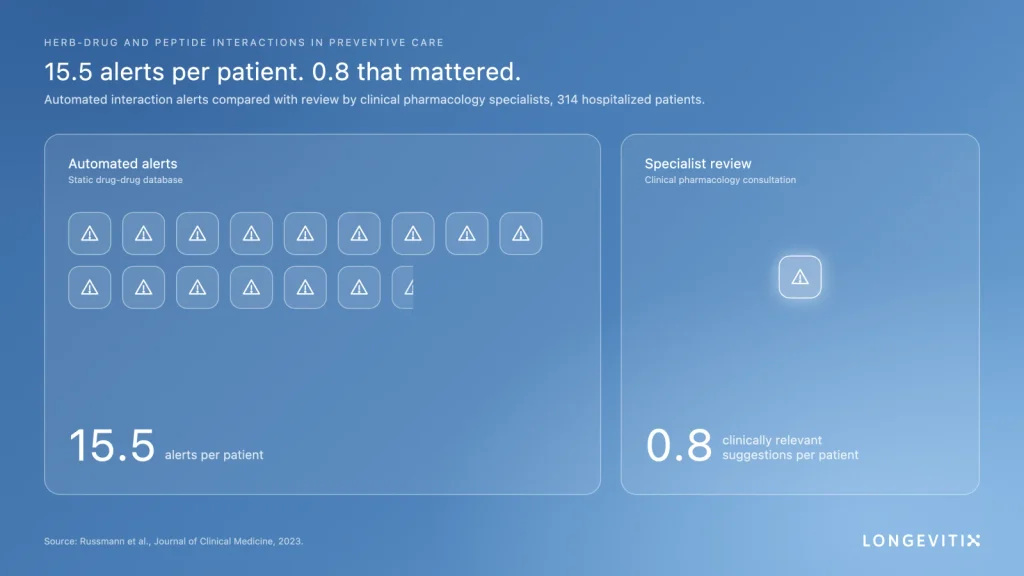
Alert fatigue: 15.5 alerts, 0.8 that mattered
A cross-sectional study of hospitalized patients compared automated interaction alerts with review by clinical pharmacology specialists (Russmann et al., Journal of Clinical Medicine, 2023). The automated system produced 15.5 alerts per patient on average. The pharmacology team made 0.8 clinically relevant suggestions per patient.
That ratio teaches physicians to ignore alerts. Most standard engines check drug-drug pairs from a static database. They fire on aspirin and warfarin every visit, with no sense of context, dose or patient.
A review in older adults found that decision support can cut potentially inappropriate medications by up to 18%, and that alert fatigue remains a persistent barrier (Ng et al., Age and Ageing, 2025).
Herb-drug and peptide interactions the system never sees
The second problem is quieter. An alert engine can only check what’s in the structured medication list. Supplements and peptides usually aren’t there (we covered why in medication reconciliation for peptides in longevity care).
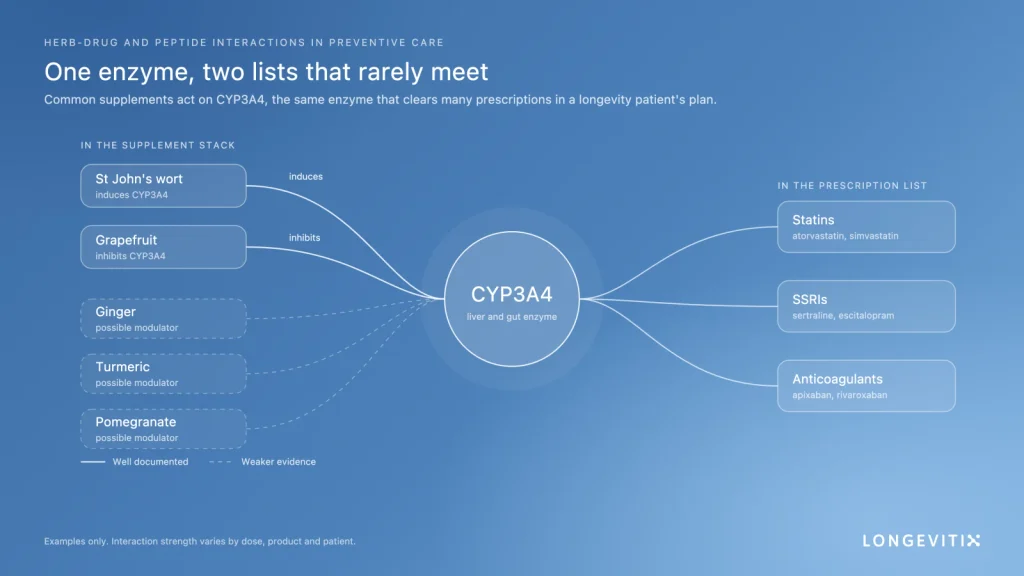
Many common supplements affect drug metabolism. CYP3A4 is the clearest example. St John’s wort induces it and grapefruit inhibits it, and ginger, turmeric and pomegranate are commonly cited as possible modulators. Plenty of longevity patients take several of these daily, alongside statins, SSRIs or anticoagulants.
Patients and clinicians both know less about these interactions than they think. A survey study on herb and supplement knowledge called directly for a “smart decision system” to detect herb-drug interactions (Dores et al., Nutrients, 2023).
GLP-1 drug interactions: a different mechanism
GLP-1 receptor agonists add a separate interaction pathway. They slow gastric emptying, which can change how fast oral drugs are absorbed.
A systematic review of GLP-1 drug interactions with oral medications describes this effect across several drug classes (Calvarysky et al., Drug Safety, 2024). For most drugs it’s modest. For drugs with a narrow therapeutic window, or where timing matters, it deserves attention. Oral contraceptives are one example: tirzepatide labeling advises a backup or non-oral method after starting and after each dose increase.
Standard alert engines rarely handle this kind of interaction. It depends on mechanism and timing, and many GLP-1 prescriptions come from telehealth services the primary clinic never sees.
Interaction checking for peptide and supplement stacks
The best evidence here comes from intensive care. A randomized trial in the Lancet tested decision support alerts tailored to the ICU setting for high-risk drug combinations (Bakker et al., Lancet, 2024). Tailored alerts outperformed generic ones.
The lesson carries over. Alerts work better when they’re specific to the setting, the patient and the drugs that matter in that practice. For a longevity clinic, that means:
- Every intervention, including supplements and peptides, entered as a structured item
- Interaction checks that cover CYP pathways and absorption effects
- Alerts filtered for clinical relevance so the important ones stand out
- Clear sourcing, so the physician can see the evidence behind each flag
How Longevitix approaches interaction checking
At Longevitix, the platform checks the full intervention set, supplements and peptides included, against curated clinical databases. It surfaces potential interactions with their evidence for the physician to review. The physician decides what is clinically relevant for this patient.
This depends on grounding. A system that cites its sources lets the physician check the reasoning. We explain why that matters in what is RAG and why it makes decision support safer.
Key takeaway
Interaction checking fails in two directions: noise on the pairs it knows, silence on the supplements it can’t see. Fixing it starts with a complete, structured list and alerts tuned to the patients a clinic treats.
FAQs
Which supplements most often interact with prescription drugs?
St John’s wort and grapefruit are the best documented CYP3A4 modulators. Ginger, turmeric and pomegranate are often cited as possible modulators, with weaker evidence.
Do GLP-1s interact with oral medications?
They slow gastric emptying, which can change absorption of oral drugs. Pay attention with narrow-therapeutic-window drugs and oral contraceptives.
How can a clinic reduce alert fatigue?
Tailor alerts to the setting. The ICU trial data shows tailored alerts outperform generic ones.
Can supplements cause liver injury?
Yes. Herbal and dietary supplements are a leading cause of drug-induced liver injury globally.
What’s the first step to better herb-drug interaction checking?
Get every supplement and peptide into the structured medication list. An alert engine can’t check what it can’t see.