Back
Peptide Therapy EMR: What Longevity Care Needs From the Chart

Effie Arditi
Co-Founder & CEO
Share:
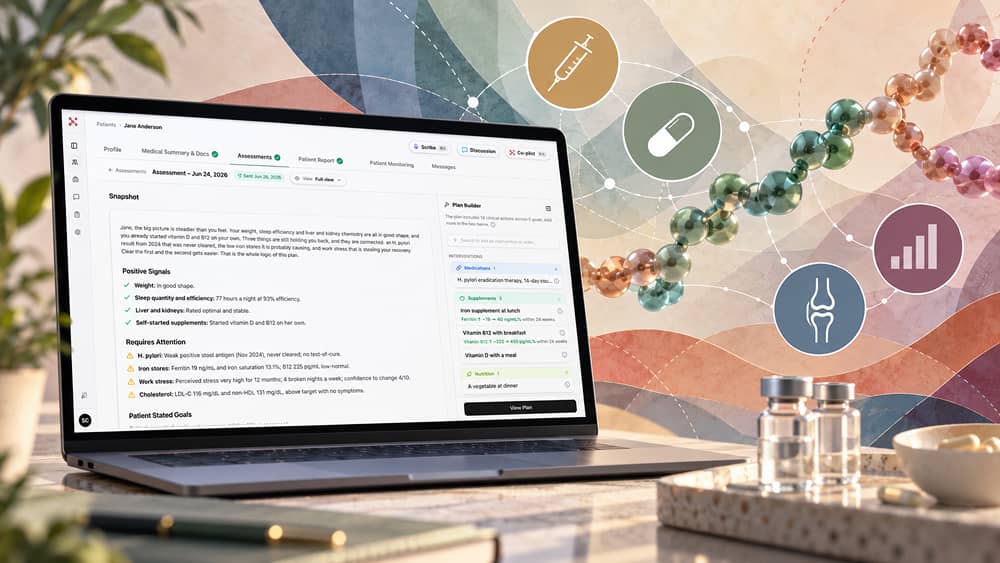
Peptides are moving into mainstream longevity care. The record systems physicians use to prescribe them haven’t changed. No mainstream peptide therapy EMR treats a peptide as structured clinical data with its own monitoring, interactions and risks.
That gap is a patient safety problem. It causes harm slowly, through interactions nobody checks and responses nobody tracks.
This article walks through one patient, explains why the medical record fails her, and sets out what a system for peptide-inclusive care has to do.
One patient, three medication lists
Consider a 52-year-old executive who sees three clinicians in the same month.
Her primary care chart lists atorvastatin, escitalopram and low-dose aspirin. Her longevity clinic plan lists tesamorelin, oral BPC-157, transdermal estradiol, oral progesterone and an NAD+ precursor. Her dermatologist’s intake form picks up a GLP-1 receptor agonist, prescribed elsewhere for weight loss.
Three offices hold three lists, and none can see the others. No system is checking whether tesamorelin is pushing her IGF-1 too high, whether her A1c needs a recheck on the GLP-1, or whether anything she injects interacts with the SSRI she has taken for ten years.
This is what integrated longevity medicine often looks like in 2026.
The peptide therapy EMR gap: no place to put a peptide
The problem sits in the data model.
In a conventional EMR, a peptide is a free-text order, a mention in a note, or a custom order set that works only inside one clinic’s build. There is no structured entity for a peptide that holds:
- Its identity, including amino acid sequence where relevant
- Its regulatory status
- Indications and contraindications
- Sex-specific dosing considerations
- A monitoring schedule
- The organ systems it affects
Without an entity, the system can’t link a peptide to labs, other drugs or outcomes. Every downstream safety check depends on those links.
Cross-organ monitoring for peptide-inclusive care
Most interventions in a longevity plan touch several organ systems at once.
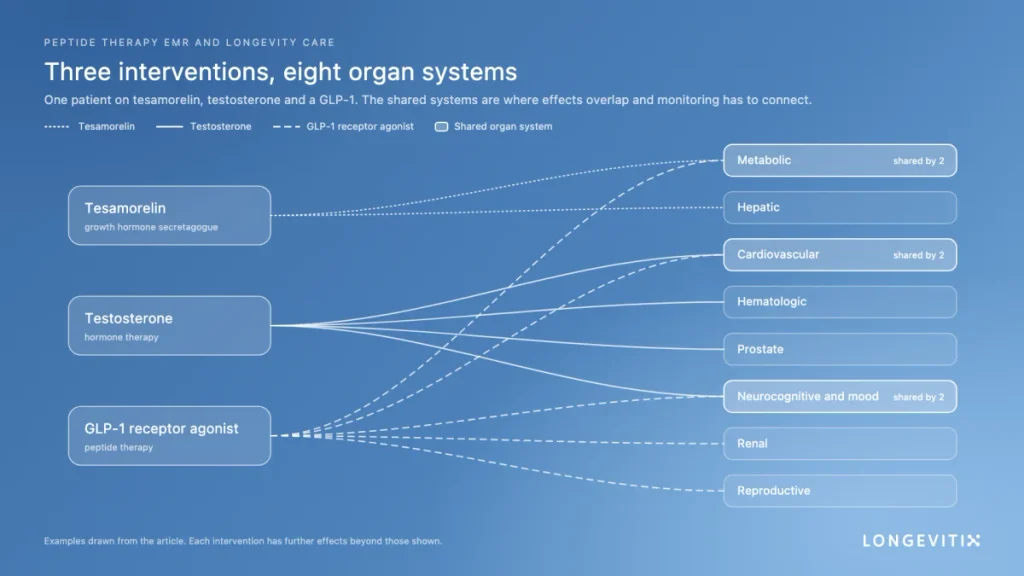
A GLP-1 affects metabolic, cardiovascular, renal and reproductive systems, and there is growing evidence for central nervous system effects (West et al., Neurology and Therapy, 2025). Testosterone affects hematologic, cardiovascular, prostate and mood domains. A growth hormone secretagogue affects glucose, body composition and IGF-1.
A patient on tesamorelin, testosterone and a GLP-1 has metabolic, hepatic, cardiovascular, hematologic, prostate and neurocognitive threads running at once. A record organized as separate organ dashboards leaves the physician to connect them by hand.
We covered the specific monitoring for each of these in the series:
- Tesamorelin monitoring in peptide therapy: IGF-1 and glucose
- TRAVERSE and testosterone therapy monitoring in longevity care
- GLP-1 sex differences: dosing women in preventive care
- BPC-157 and investigational peptide monitoring
Where current peptide therapy tools fit
The tools around peptide care each solve one part of the problem.
Direct-to-consumer peptide telehealth services solve access. Niche EMRs built for wellness and functional medicine clinics offer peptide protocol templates, e-prescribing and documentation. Standard EHRs serve as the system of record. Third-party drug references provide information at the point of prescribing.
None of them reasons across a patient’s full intervention set: connecting peptides to labs, flagging cross-organ effects, accounting for sex, grading evidence and scheduling monitoring.
What a system for peptide-inclusive care has to do
Three properties matter most.
First-class representation. Peptides, hormones and supplements need the same structured treatment as any prescription drug. If the system can’t see an intervention as an entity, it can’t reason about it.
Cross-organ surfacing. The system should present the relationships activated by the current intervention set, so the physician sees the multi-organ picture without rebuilding it.
Monitoring as part of the intervention. When a peptide enters the plan, its monitoring should enter with it as dated items the physician can confirm, defer or edit. Proactive monitoring can’t survive as a manual habit across a full patient panel.
The attending and the resident
The best model for this kind of decision support is a well-trained resident.
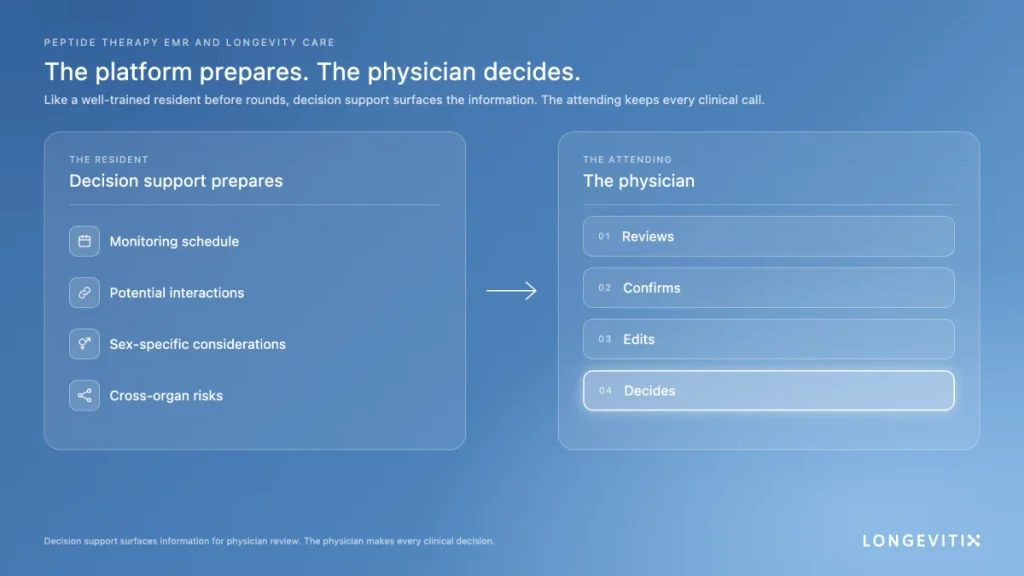
Before rounds, a good resident prepares the differential, the monitoring schedule, the sex-specific considerations and the cross-organ risks. The attending reviews it, confirms what fits, changes what doesn’t, and makes the call.
That is how we built Longevitix. The platform does the preparation and surfaces the information. The physician keeps full clinical judgment over every decision. We wrote more about this division of work in why AI’s greatest value in longevity medicine is what it doesn’t do.
Key takeaway
Peptide prescribing is growing faster than the infrastructure to monitor it. Treating peptides as structured clinical data is overdue as a patient safety step.
FAQs
Can I document peptides in Epic or Cerner?
Usually as free-text orders or custom order sets. These entries generally don’t trigger interaction checks or monitoring schedules.
What is peptide-inclusive care?
Care in which peptides, hormones and supplements are tracked, monitored and checked for interactions with the same rigor as prescription drugs.
Why does cross-organ monitoring matter for peptides?
Most peptides and hormones affect several organ systems. Monitoring one system at a time misses interactions between them.
Does decision support replace physician judgment?
No. It prepares information for the physician to review. The physician makes every clinical decision.
What’s the first step for a clinic?
Record every peptide, hormone and supplement as a structured item with dose, source and start date, and attach a monitoring schedule at the time of prescribing.