Back
Sunscreen and Skin Aging: The Trial Most Routines Ignore
Effie Arditi
Co-Founder & CEO
Share:
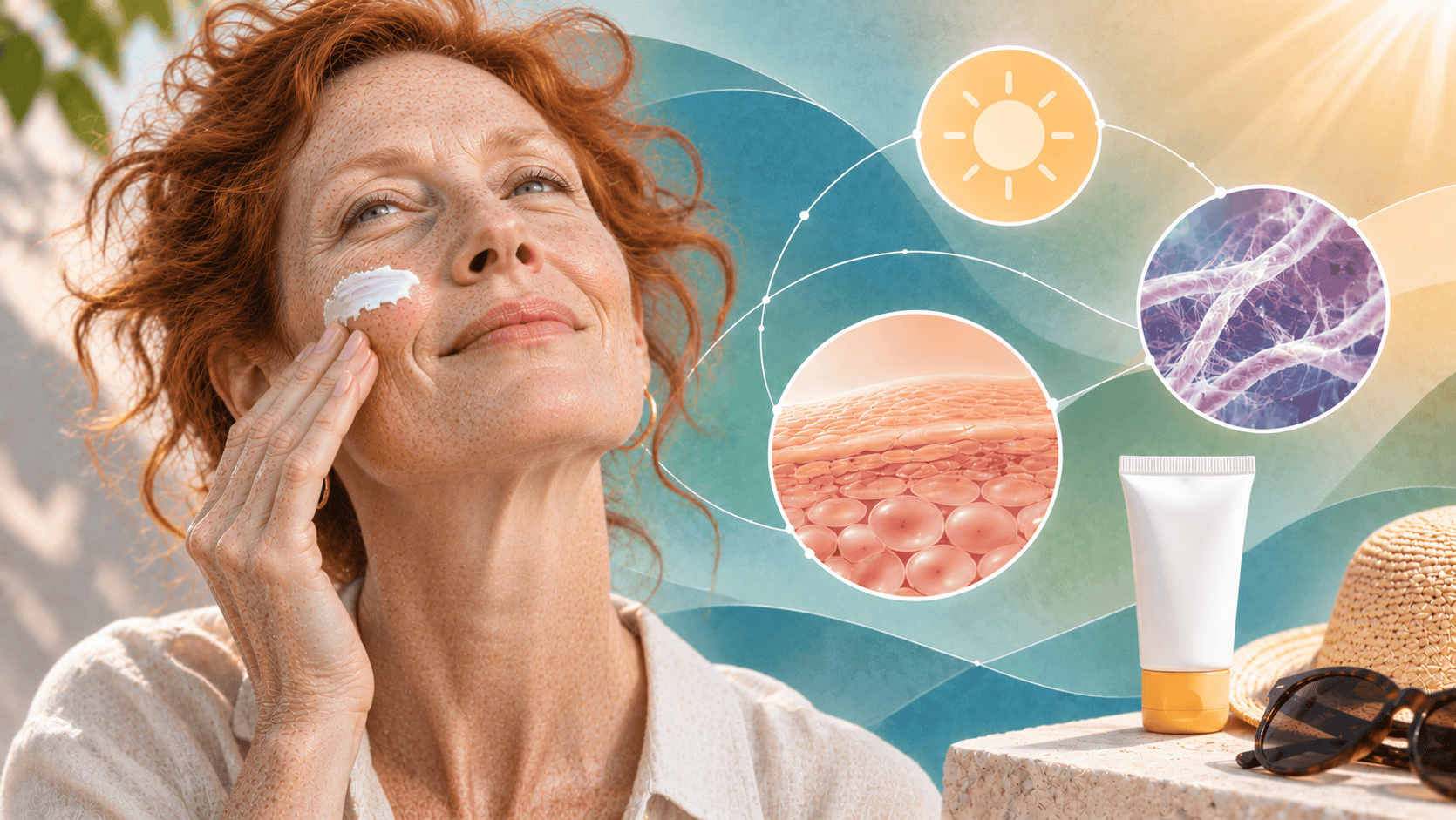
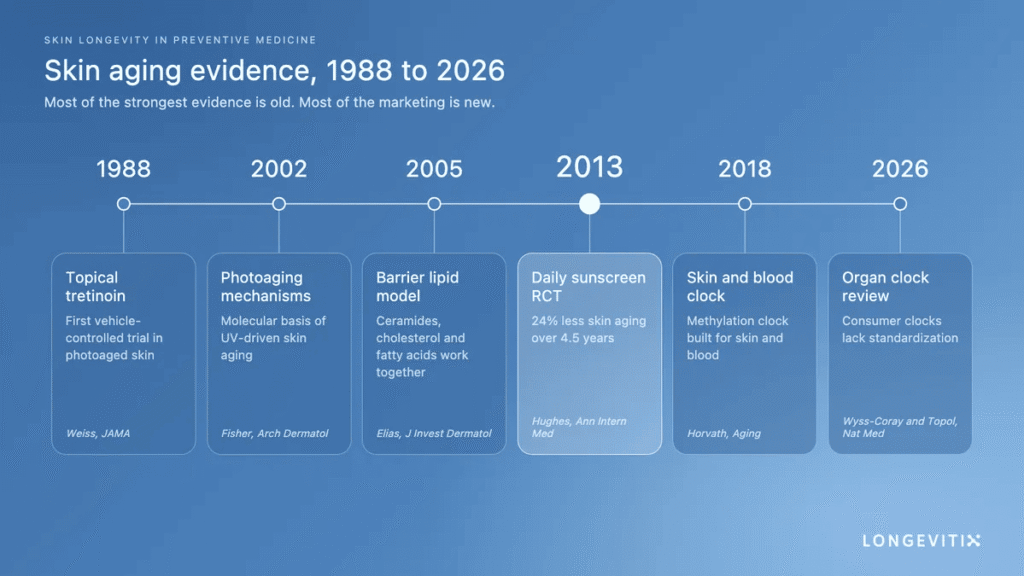
In 2013, the Nambour trial showed that daily sunscreen slows visible skin aging in a randomized design. Since then, the skincare market has cycled through retinol alternatives, growth factors, stem cell serums and exosomes. The research on sunscreen and skin aging has barely moved clinical habits.
Most physicians still file sunscreen under cosmetics or skin cancer. It belongs in preventive medicine too.
What the Nambour trial found
Researchers in Nambour, Queensland, randomized 903 adults under 55 to daily broad-spectrum SPF 15+ sunscreen or discretionary use. A factorial arm tested beta-carotene supplements at the same time. Follow-up ran four and a half years.
Skin aging was graded from silicone impressions of the back of the hand, a measure called microtopography. Graders were blinded.
The results (Hughes et al., Annals of Internal Medicine, 2013):
- The daily-sunscreen group showed no detectable increase in skin aging over the study period.
- Their increase in skin aging was 24% lower than the discretionary group’s.
- Beta-carotene had no overall effect.
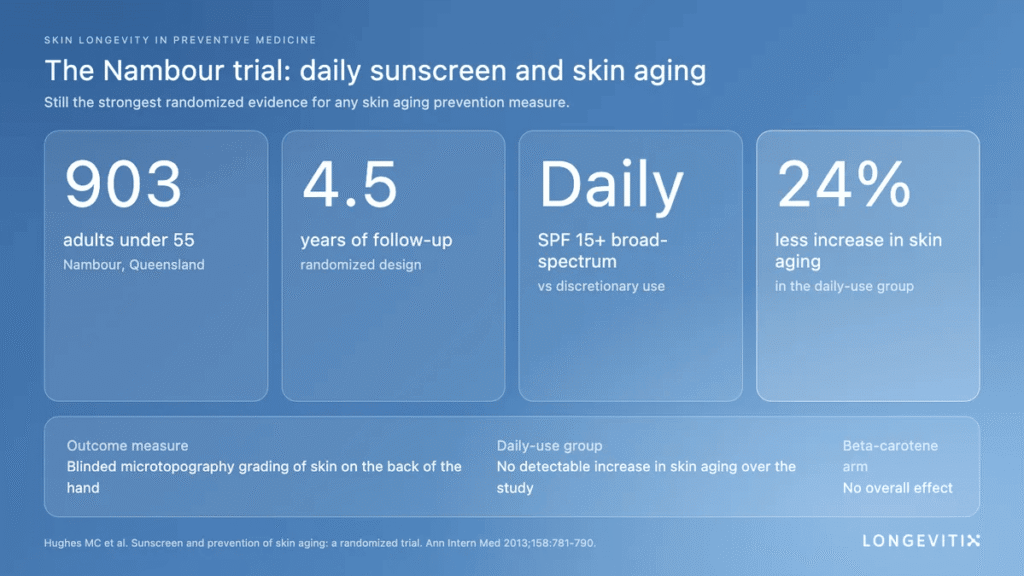
Nambour trial summary: 903 adults, 4.5 years, daily sunscreen, 24% less increase in skin aging
The Nambour trial at a glance. Source: Hughes et al., Annals of Internal Medicine, 2013.
No other skin longevity intervention has a randomized trial of this size and length behind it.
Why UV drives most visible aging
Dermatologists have long estimated that UV exposure accounts for up to 80 to 90% of visible facial aging. The figure comes from twin studies and from comparing sun-exposed with sun-protected skin (Flament et al., 2013). Treat it as a longstanding estimate.
UV damage works through several of the pathways in our skin longevity framework: DNA damage, collagen breakdown, oxidative stress and local inflammation.
Why daily sunscreen is under-prescribed
Three habits keep sunscreen out of preventive plans:
- It’s framed as cosmetic. A retinoid for photoaging prevention gets the same treatment, even with decades of trial data behind it.
- It’s cheap and unmarketed. Nobody sells it to patients with the energy behind a $300 serum.
- It drops first. When a routine gets too expensive or irritating, patients cut the simplest step. That is often the one with the best evidence.
The core preventive set for skin aging
The skeptic’s view says SPF and tretinoin are all you need. At the population level, that’s close to right.
A short core set covers most of the modifiable variance for most patients:
- Daily broad-spectrum sunscreen.
- A tolerated topical retinoid. Tretinoin has randomized trial support for photoaging since 1988 (Weiss et al., JAMA).
- Barrier support with physiologic lipids. See skin barrier repair.
- No smoking.
- Adequate sleep.
Everything else is a marginal addition, and whether it helps depends on the patient.
Prescribing sunscreen like a preventive intervention
Treat it the way you’d treat any long-term therapy:
- Pick a formula the patient will use every day. Texture, finish and tint drive adherence more than SPF number. The American Academy of Dermatology advises SPF 30 or higher.
- Ask about use the way you ask about a statin. “Most mornings” is a real answer and worth recording.
- Address the absorption question directly. Some sunscreen actives reach measurable blood levels (Matta et al., JAMA, 2020). The FDA’s position is that absorption alone does not establish harm. Patients worried about specific filters can use mineral formulas.
- Consider pigment in deeper skin types. Tinted mineral formulas help with tolerability and visible results in darker phototypes.
FAQs
Does sunscreen prevent skin aging? Daily use slowed measurable skin aging in a 4.5-year randomized trial of 903 adults. That is the strongest RCT evidence for any skin aging prevention measure.
What SPF did the trial use? SPF 15+ broad-spectrum. Current American Academy of Dermatology guidance is SPF 30 or higher.
Is sunscreen absorbed into the bloodstream? Some chemical filters are absorbed at measurable levels. Absorption alone does not show harm. Mineral filters (zinc oxide, titanium dioxide) are an option for concerned patients.
Is tretinoin preventive or cosmetic? Both labels fit. Randomized trials show it reverses signs of photoaging, which gives it a place in a preventive plan alongside sunscreen.